
Homeowners insurance rarely covers foundation repair in Birmingham, because standard policies exclude earth movement — which captures both fill consolidation and red clay movement. The exception that pays is a sudden accidental plumbing leak. On newer homes, the builder warranty is often the better route.
What the exclusion actually says, the plumbing exception, and the documentation advantage available on an engineered pad.
The exclusion is broader than people expect
The earth movement clause in a homeowners policy is drafted to sweep widely — seismic activity, slides, mudflow, subsidence, and then explicitly the settling, cracking, shrinking, bulging, and expansion of foundations. Both of the things that move Birmingham houses land inside that list. Fill compressing beneath a building is settling by definition. Clay swelling and shrinking is expansion and contraction by definition.
Reading your own wording is worth twenty minutes. It usually appears under a heading like “Earth Movement” in the Section I exclusions, and the specific language in your policy governs — not what a contractor says and not what a neighbor was paid.
The exception that actually pays
Picture a supply line letting go under a slab. Water gets out, soil beneath a footing washes or softens, and the house responds. Wordings generally treat that as sudden and accidental discharge and pay for the resulting damage, frequently including the demolition needed to reach the failure. The pipe itself is usually the homeowner's to replace.
Everything turns on that one adjective. A joint that has been weeping quietly for several years falls under long-term seepage in most wordings, so proving when counts for as much as proving what. Which is the argument for getting a dated isolation test done before a claim is opened rather than in response to a request for evidence.
The second door: your builder warranty
On a house young enough, this is the more promising route and it gets checked first. Builder warranties commonly cover grading and drainage for a defined window, and sometimes structural performance for considerably longer. Given that the dominant local mechanism is fill consolidation on a constructed pad, a warranty claim is arguing about workmanship rather than about an act of nature — a much better argument to be having.
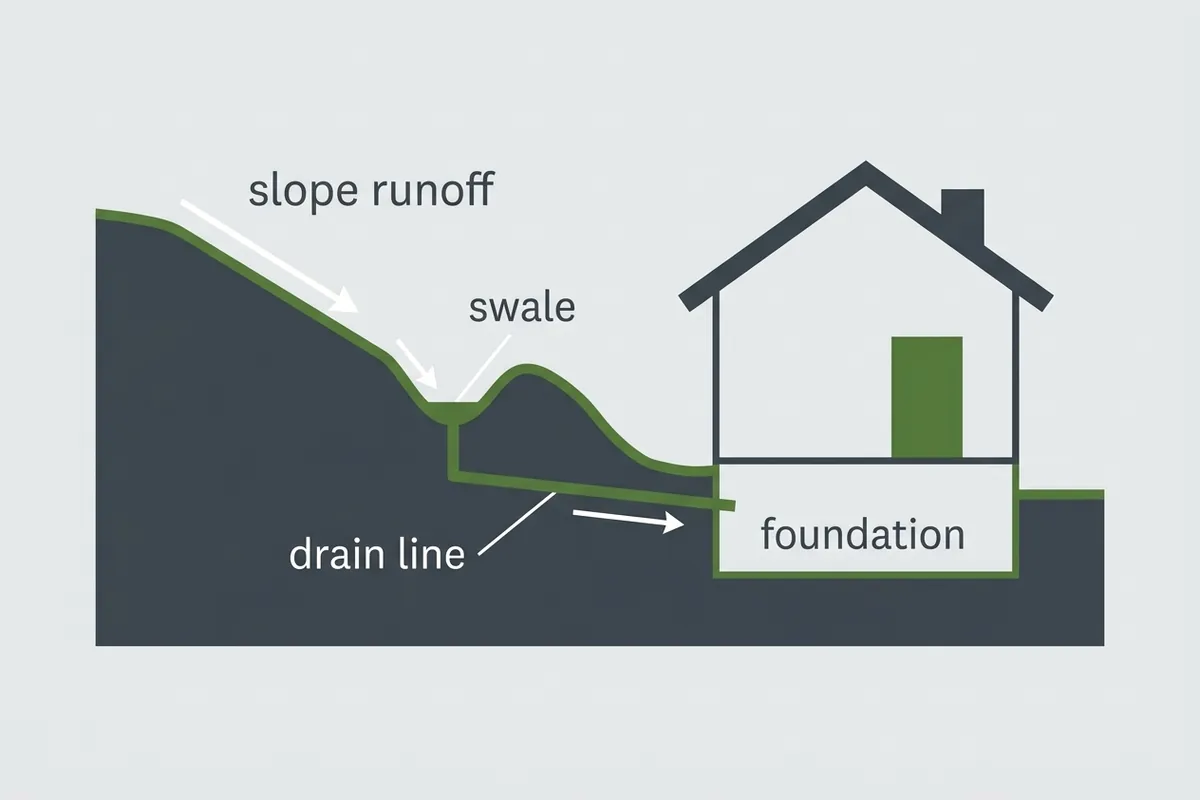
Evidence is what carries it: elevation figures with dates on them, crack widths actually measured, and photographs showing grade and where runoff collects. Ask for that document from the evaluation regardless of who ends up doing the work. A household that got its builder to pay is better off than one that paid a contractor without ever raising the question.
The paperwork advantage
Here is something Birmingham homeowners have that owners in a natural-soil market usually do not. A benched pad was designed and built, which means documents may exist — grading plans, soils reports, compaction testing records — held by the builder, the developer, or in local permitting files.
They are not always obtainable, and nobody can promise they are. But where they surface, they convert a dispute about causation into a comparison between what the specification required and what the ground is now doing. That is a materially stronger position than most foundation claimants ever occupy, and it costs nothing but a few phone calls to find out.
What a documented claim contains
| Evidence | Why it decides the outcome |
|---|---|
| Floor elevation readings across the footprint | Quantifies the movement and shows its direction |
| Dated crack measurements | Establishes when movement began and whether it continues |
| Photographs of grading and discharge points | Supports a grading or drainage warranty claim |
| Plumbing isolation test | The only route to a covered insurance cause |
| Grading plan or soils report, if obtainable | Compares as-built ground to what was specified |
| Your policy’s earth movement wording | Determines which argument is even available |
Work out the cause first
Find out what is actually happening before anything gets filed. An elevation survey, plus an isolation test where a line is suspected, tells you whether a covered cause is even in play. Reverse that order and you can end up with a refusal recorded against the address that paid you nothing. Ask for the documentation either way. Nobody at the evaluation can forecast an outcome. That sits with you, your agent, and the wording you signed. Uninsured pricing lives in the cost guide.
Coverage, answered plainly
Does homeowners insurance cover foundation repair in Alabama?
Standard policies exclude earth movement, and that exclusion is written broadly enough to include settling, cracking, shrinking, expansion, and sinking of foundations. Fill consolidation and red clay movement both sit inside it. The exception that pays is damage from a sudden accidental plumbing discharge.
What is the plumbing exception?
If a supply or drain line fails suddenly and escaping water undermines soil beneath a footing, many policies cover the resulting damage and the tear-out required to reach the pipe - though usually not the pipe repair itself. The word doing the work is sudden; a slow seep running for years is generally excluded.
Is a builder warranty a better route than insurance?
On a newer house, frequently yes, and it is the first thing to check. Grading, drainage, and in some cases structural performance are commonly covered for defined periods, and a documented water path or elevation survey is exactly the evidence such a claim needs. Check the warranty before you check the policy.
Can I find out how my pad was built?
Sometimes, and this metro is better for it than most. Grading plans, soils reports, and compaction testing records exist for many developments and are occasionally obtainable from the builder, the developer, or local permitting records. Where they surface, they turn an argument about causation into a document.
Should I file a claim if I am unsure?
Ask your agent how inquiries are recorded before filing. Claims history follows a property, and a denied earth-movement claim can affect future pricing while paying nothing. Establish the cause first with an elevation survey and, where a leak is suspected, a plumbing isolation test.
Get a Birmingham foundation evaluation
Describe what the house is doing — a crack that keeps opening, a door that stopped latching, floors that fall away toward one side, a retaining wall starting to lean. If you already hold a bid from somebody else, keep it handy and read its warranty before you sign anything. A local specialist serving Birmingham calls you back.